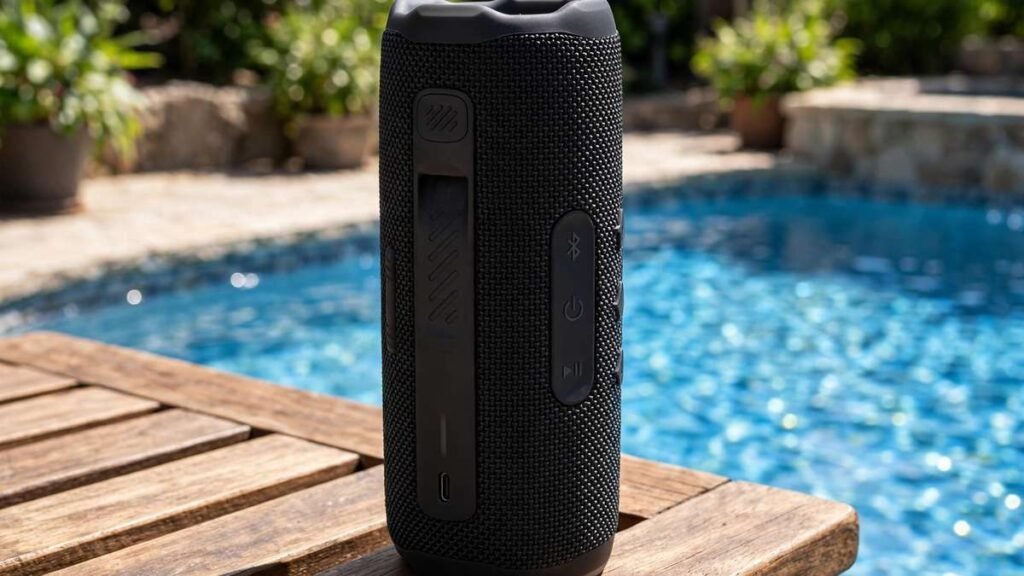
The JBL Flip is the default portable Bluetooth speaker — the one everyone compares everything else to — and the Flip 7 is the best one JBL has ever made. At $146–$179 in Australia, it takes the Flip 6’s already class-leading formula and adds the upgrades that actually matter: IP68 waterproofing, Auracast multi-speaker pairing, AI Sound Boost for cleaner loud volume, a PushLock mount system, and USB-C lossless audio. Reviewers call it the new portable speaker boss, even better than the class-leading old boss. The question for Australians isn’t whether it’s good — it’s whether it’s worth replacing the Flip 6 you probably already own.
Launched in March 2025, the Flip 7 is on shelves across Australia right now — and the street price has already drifted below its $199.95 launch price. Here’s the honest Australian breakdown: where it’s cheapest, what’s genuinely new, and the Flip 6 upgrade question answered properly.
Quick verdict
The Flip 7 is the most complete portable speaker under $200 in Australia: 35 watts of punchy, detailed sound from a 45×80mm woofer and a redesigned tweeter dome, IP68 waterproof/dustproof/drop-proof build, 14 hours of battery (16 with Playtime Boost), Auracast pairing for stereo or party mode with other JBL speakers, and wired USB-C lossless playback. Reviewers consistently rate it the class leader. The honest caveats: it won’t stereo-pair with your old Flip 6, there’s no charging cable in the box, and the Flip 6 now sells for around $112–$120 — about $30 less. Buy the 7 if you’re buying your first Flip or your old one is dying; keep the 6 if it still works fine, because the upgrade is evolutionary, not revolutionary.
JBL Flip 7: Australian price and where to buy cheapest
Here’s the current price picture (checked 8 October 2026):
$146 — Harvey Norman — “SAVE $29” badge, in stock. The cheapest verified price at a major Australian retailer right now.
$179 — The Good Guys — in stock across multiple colours (black, blue, pink). Australia’s biggest appliance retailer, $33 above the cheapest.
$179 — CHOICE-listed price — CHOICE’s product listing also shows $179, confirming the street price has settled.
$199.95 — Australian launch RRP — the local launch price reported by Australian press at release. The street has drifted $20–$54 below it, which is normal for JBL a year after launch.
Harvey Norman’s $146 “SAVE $29” badge makes it $33 under The Good Guys right now — worth the extra click for this one. Smaller sellers occasionally go lower, but stock and warranty support get patchier. Confirm the price before checkout — portable audio prices move with sale cycles, and the November sales could push it lower still.
JBL Flip 7: key features and specs
- 35W two-way sound: 45×80mm (1.75×3″) woofer with 25W RMS plus a 16mm (0.6″) tweeter with a redesigned dome for clearer highs — 10W RMS to the tweeter
- AI Sound Boost: analyses the music signal in real time and adjusts output for fuller sound with less distortion at high volume — most noticeable outdoors
- IP68 waterproof, dustproof and drop-proof: survives immersion, sand, and a 1-metre drop onto concrete thanks to shock-resistant rubber trim
- Battery: 14 hours standard playtime, 16 hours with Playtime Boost (which trims low-frequency presence); 4,800mAh Li-ion polymer cell
- 2.5-hour charging via USB-C (5V/3A) — but no USB-C cable included in the box
- Auracast multi-speaker pairing: wirelessly link multiple Auracast-enabled JBL speakers for stereo or party mode; two Flip 7s make a true stereo pair
- USB-C lossless audio: plug into a phone or laptop for wired, lossless playback — a first for the Flip line
- PushLock interchangeable accessories: loop and carabiner included, swappable via the new magnetic PushLock mount system
- Bluetooth 5.4 for stable wireless connection
- JBL Portable app: 7-band EQ, firmware updates and control customisation
- Frequency response: 60Hz–20kHz
- Size and weight: 182.5mm × 69.5mm × 71.5mm, 0.56kg — fits a backpack side pocket or cup holder
- No microphone — you can’t take calls on it
- Colours: black, blue, red, purple, white, pink and Squad (camouflage)
- Eco build: 30% recycled plastic and fabric, FSC-certified packaging with soy ink
- Warranty: 1 year (AU)
The spec that matters most is the combination of toughness and connectivity. Plenty of speakers are loud; few at this price are IP68, drop-proof, Auracast-ready and lossless-capable at once. That’s the gap the Flip 7 was built to fill.
What makes the Flip 7 different
AI Sound Boost is the real upgrade. Small speakers distort when pushed — it’s physics. The Flip 7’s AI Sound Boost analyses the incoming signal and reshapes output on the fly, keeping bass punchy and highs clean at volumes where the Flip 6 would start to strain. Reviewers consistently note the 7 sounds fuller and more controlled at high volume, which is exactly where a portable speaker lives at a barbecue or the beach. It’s the single most audible difference between generations.
IP68 plus drop-proofing makes it genuinely go-anywhere. The Flip 6 was IP67; the 7 goes to IP68 and adds proper drop protection — JBL says a 1-metre drop onto concrete won’t stop it. For a speaker designed to live in beach bags, on boat decks and next to pools, that’s not marketing fluff, it’s the difference between a speaker you baby and one you throw in the bag. It’s part of the same 2026 wave of take-anywhere tech as the wearables in our Galaxy Buds 4 Pro review — gear built for real life, not the shelf.
Auracast is future-proofing that works today. Auracast is Bluetooth’s new broadcast audio standard, and the Flip 7 speaks it: link multiple Auracast-enabled JBL speakers for a synchronised multi-room or party setup, or pair two Flip 7s as a proper stereo pair. The catch — and it’s worth knowing — is that Auracast only talks to Auracast: your old Flip 6 can’t join the party. JBL’s ecosystem play rewards buying current-gen.
USB-C lossless is the audiophile bonus. Plug the Flip 7 into your laptop or phone over USB-C and it plays wired, lossless audio — no Bluetooth compression. For a $146 speaker this is a genuinely unusual feature, and it means the Flip 7 doubles as a decent desktop speaker, not just a beach box.
The honest downsides. It won’t pair with previous Flip models, so a Flip 6 + Flip 7 stereo setup is impossible — a deliberate ecosystem nudge that will annoy upgraders. There’s no USB-C cable in the box (JBL cites cutting plastic use; you’ll supply your own). There’s no microphone, so no speakerphone calls. And at 2.5 hours it doesn’t charge particularly fast. None of these are dealbreakers, but they’re all worth knowing at $146.
How it compares to rivals at Australian prices
At $146–$179, the Flip 7 sits in the most contested part of the portable speaker market:
- JBL Flip 6 (~$120 AU street) — the upgrade question itself: the 6 is a five-star speaker that’s now about $30 cheaper. It has IP67 (vs IP68), no Auracast, no AI Sound Boost, no USB-C lossless, and 12-hour battery (vs 14–16). Sound quality is close at moderate volume; the 7 pulls ahead when pushed. Buy the 6 if yours died and you want the cheapest great Flip; buy the 7 for the features and the longer support life.
- JBL Charge 6 (~$200–$229 AU) — the step up within JBL: more powerful and punchier with deeper bass, better battery (up to 24–28 hours), and a USB-C powerbank to charge your phone. But it’s bigger, heavier and $25–$50 more. Buy the Charge 6 if sound-per-dollar at home matters most; buy the Flip 7 if portability wins.
- Beats Pill ($250 AU) — the style rival: similarly portable with good sound, but $70+ more expensive in Australia and outgunned on ruggedness (no IP68/drop-proofing story to match). Buy the Pill for the brand; buy the Flip 7 for the value.
- Sonos Era 100 SL ($289 AU) — the home-listening alternative: a superb smart speaker for the house, but it’s mains-powered, not portable, and $110 more. Different job entirely. Our Sonos new-speaker breakdown covers it. Buy Sonos for the living room; buy the Flip 7 for everywhere else.
The pattern: nothing under $200 matches the Flip 7’s combination of sound, toughness and features. The Flip 6 is the value pick, the Charge 6 is the power pick, and the Flip 7 is the sweet spot between them.
Who should buy it
Buy the Flip 7 if: you want the best all-round portable speaker under $200 — beach, backyard, camping, shower singing; your old Flip (5 or earlier) is dying and you want the modern feature set; you want a speaker you can throw in a bag without a second thought; or you like the idea of stereo-pairing two of them down the track.
Think twice if: your Flip 6 still works — the upgrade is real but evolutionary, and ~$30 is ~$30; you mainly listen at home — a mains smart speaker like the Sonos gives you more for the money; you need speakerphone calls — there’s no mic; or you’re buying for a pool that never sees a beach — the IP68 story is wasted on the kitchen bench, though the sound isn’t. For more take-anywhere tech in the same price band, our Ring Spotlight Cam 2K review covers another $200-ish outdoor upgrade.
Final verdict
The JBL Flip 7 is the best portable Bluetooth speaker you can buy in Australia under $200: class-leading sound with AI Sound Boost, IP68 toughness, Auracast pairing, USB-C lossless and 16-hour battery — all for $146 at Harvey Norman ($179 at The Good Guys). Reviewers are unanimous, and the street price has already settled $54 under launch RRP. Buy it as your first Flip or as a replacement for an ageing one; keep your Flip 6 if it’s still going strong, because the upgrade — good as it is — isn’t worth $146 on its own. And if the November sales push it lower still, that’s the time the fence-sitters should jump.
JBL Flip 7: frequently asked questions
How much is the JBL Flip 7 in Australia?
The Australian launch RRP was $199.95, but the street price has settled lower: Harvey Norman lists it at $146 (“SAVE $29” badge, in stock, the cheapest major-retailer price), The Good Guys at $179 (in stock, multiple colours), and CHOICE lists $179. Prices checked 8 October 2026 — confirm before checkout, as portable audio prices move with sale cycles.
What is the difference between the JBL Flip 7 and the Flip 6?
The Flip 7 upgrades to IP68 waterproofing (from IP67) with drop-proofing, adds Auracast multi-speaker pairing, AI Sound Boost for cleaner loud volume, USB-C lossless wired playback, the PushLock accessory mount system, and longer battery (14–16 hours vs 12). The Flip 6 now sells for around $112–$120 — about $30 less — and still sounds great at moderate volume.
How long does the JBL Flip 7 battery last?
JBL rates it at 14 hours of standard playtime, or 16 hours with Playtime Boost enabled (which slightly trims bass presence). A full recharge takes about 2.5 hours over USB-C — note no cable is included in the box. Real-world runtime drops at high volume, as with any portable speaker.
Is the JBL Flip 7 waterproof?
Yes — it’s IP68 rated for water and dust, and JBL rates it drop-proof from 1 metre onto concrete thanks to shock-resistant rubber trim. It’ll survive pool splashes, beach sand and rain. JBL notes the speaker should be dry before charging via the USB-C port.
Is the JBL Flip 7 worth upgrading from the Flip 6?
It’s worth it if your Flip 6 is ageing or you want the new features — AI Sound Boost, Auracast pairing, USB-C lossless and IP68 toughness are genuine upgrades, and reviewers rate the 7 clearly ahead at high volume. It’s not worth it if your Flip 6 still works fine: the upgrade is evolutionary, the 6 now costs around $120, and the 7 can’t stereo-pair with older Flips anyway.