Quick verdict
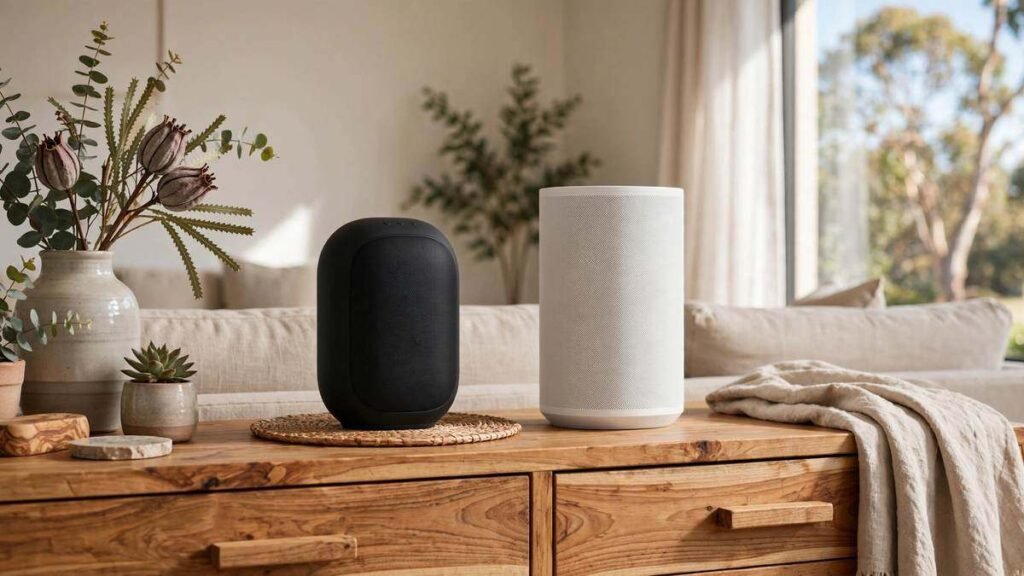
Sonos’ first new speakers since 2024 do two different jobs. The Sonos Play is $499 in Australia — a portable, weatherproof speaker with a 24-hour battery that slots between the $299 Roam 2 and the $799 Move 2. The Sonos Era 100 SL is $289 ($285 at Harvey Norman) — the same Era 100 hardware minus the microphones, and the cheapest way into the Sonos system in Australia. Buy the Play if you want music that follows you outdoors. Buy the Era 100 SL if you want a great-sounding, privacy-friendly speaker that never leaves the house. The catch reviewers have flagged: the Play doesn’t sound $180 better than the cheaper Era 100, so be honest about how much portability matters to you.
Sonos Play and Era 100 SL: Australian price and where to buy cheapest
Here’s the current price picture (checked 8 October 2026):
$499 — Sonos Play — Australian RRP, listed at the same price across price-comparison listings. It launched 31 March 2026 after a pre-order period through Sonos’ own store.
$289 — The Good Guys — Era 100 SL in stock at RRP, black or white.
$285 — Harvey Norman — Era 100 SL (black or white) listed slightly under RRP in its offers feed; the cheapest price we’ve seen in Australia.
Both speakers launched on the same day (31 March 2026), marking Sonos’ return to new hardware after the company’s difficult 2024 app relaunch. For context: the mic-equipped Era 100 now sells at $319, so the SL’s $289 price is a modest $30 saving for giving up the microphones — and at Harvey Norman’s $285 it’s the cheapest Sonos speaker on sale in Australia. Confirm the price before you buy, since retailer listings can move.
Sonos Play: key features and specs
The Play is Sonos’ “most versatile speaker” — a battery-powered box designed to live on a bookshelf and travel to the backyard. Inside: three class-H digital amplifiers, two angled tweeters, one midwoofer and dual force-cancelling passive radiators — broadly the same acoustic package as the Era 100, with extra passive radiators to fatten the bass. Published specs list a far-field microphone array, and the speaker supports Apple AirPlay 2 and Spotify Connect alongside Wi-Fi multi-room.
Portability is the Play’s reason to exist: a 35Wh battery rated for up to 24 hours of playback, IP67 dust and water resistance (a step up from the Move 2’s IP56 — it can survive submersion), Wi-Fi 6, Bluetooth 5.3 and a USB-C port that handles line-in, Ethernet and phone charging. A wireless charging base comes in the box, and Sonos sells a battery replacement kit so you can swap the battery when it eventually degrades. It weighs 1.3kg and measures 192 x 113 x 77mm — not a backpack speaker, but far easier to carry than the 3kg Move family.
The party trick is grouping: two Plays can be stereo-paired, and up to four Play (or Move 2) speakers can be grouped over Bluetooth — Sonos’ first product to allow Bluetooth grouping — so you can build a pseudo-surround setup outdoors with no Wi-Fi in sight. Colours: black or white in a matte finish.
Sonos Era 100 SL: key features and specs
The Era 100 SL is simpler to explain: it’s 2023’s Sonos Era 100 with the microphones removed. Everything else survives — two angled tweeters, one midwoofer, three class-D amplifiers, Wi-Fi 6, Bluetooth 5.3, Apple AirPlay 2, Spotify Connect, a USB-C port (line-in via a sold-separately adapter) and Sonos’ automatic Trueplay tuning (the full iPhone-based version; the mic-free design means there’s no Quick Tuning).
What you lose is voice control: no Alexa, no Sonos Voice Control, no smart assistant listening at all. For some buyers that’s a feature — a privacy-friendly speaker that can sit in a bedroom or study without any embedded microphones. It measures 182.5 x 120 x 130.5mm and weighs 1.95kg, comes in black or white, and like every Sonos speaker it can be stereo-paired with a twin or used as rear surrounds with a Sonos soundbar (Arc, Arc Ultra, Beam Gen 2 or Ray) for home theatre.
Sonos says the SL was re-engineered from the top down to hit its price — not simply an Era 100 with the mics unsoldered — and independent reviewers found no acoustic compromise versus the original.
Head-to-head: Sonos Play vs Era 100 SL
These are two different answers to “what’s my first (or next) Sonos?” — so the comparison comes down to where you listen.
Sound. On paper the Play has the edge: Era 100-class drivers plus dual passive radiators. In practice, independent listening found the Play slightly less full than the Era 100 — narrower stereo separation and less pronounced sub-bass from the smaller cabinet. The Era 100 SL, meanwhile, sounds identical to the $319 Era 100 for $289. On pure sound-per-dollar, the SL wins comfortably.
Portability. This is the Play’s entire pitch: 24-hour battery, IP67, Bluetooth grouping, 1.3kg. The Era 100 SL is mains-powered and stays put. If your speaker never leaves the room, you’re paying $499 for a battery and waterproofing you don’t use.
Voice and privacy. The Play keeps its microphones (per published specs); the Era 100 SL has none, and can’t run any voice assistant. If you want voice control, the SL rules itself out — you’d need the full Era 100 at $319.
Home theatre. The Era 100 SL can serve as wireless rear surrounds for a Sonos soundbar — a genuinely useful upgrade path. The Play is a music-first portable; it’s not the home-theatre pick.
The $210 gap. Play at $499 versus Era 100 SL at $285–289 is a $210 difference. That buys portability and water resistance — but slightly worse sound-per-dollar than the cheaper speaker. If you mostly listen at home, the SL is the smarter buy. If you picnic, camp, or host outdoors, the Play earns its premium.
How they compare to the competition at Australian prices
Inside Sonos’ own range, the positioning is deliberate: Roam 2 at $299 (ultra-portable), Play at $499 (versatile portable), Move 2 at $799 (big portable). The Play is the middle child — and the one reviewers called the most sensible for most people, provided you actually use the portability.
Outside Sonos, the Google Home Speaker (2026) at $199 undercuts both on price with Gemini voice smarts — but its best features need a subscription, and it can’t match Sonos’ multi-room ecosystem. See our Google Home Speaker first look if voice assistance matters more to you than sound. Apple’s HomePod mini sits at $199 too, for the Apple-committed.
For the living room, the Era 100 SL’s real rival is its own sibling: the full Era 100 at $319. The SL only makes sense if you definitely don’t want microphones — otherwise $30 extra buys you voice control and Quick Tuning. And if your TV setup centres on Google’s hardware rather than a Sonos soundbar, our Google TV Streamer 4K coverage covers that ecosystem’s audio options instead.
Who should buy them
Buy the Sonos Play ($499) if: you want one speaker for the kitchen and the campsite; you host outdoors and like the idea of grouping up to four speakers over Bluetooth; you value the 24-hour battery and IP67 toughness; or you’re already in the Sonos ecosystem and want a portable that slots into your multi-room setup.
Buy the Sonos Era 100 SL ($285–289) if: you want the cheapest entry into Sonos without compromise on sound; the idea of microphones in a bedroom speaker bothers you; you need affordable rears for a Sonos soundbar; or your speaker will live on a shelf and never move — in which case the Play’s battery is dead weight in the price.
Buy neither if: voice control is non-negotiable (get the full Era 100 at $319), you need the absolute best sound per dollar (the SL is close, but wired speakers still win), or you’re building the wider connected home — for the security side of that, our Ring Spotlight Cam 2K (2nd Gen) breakdown is the companion read.
Final verdict
The Sonos Play is a good speaker at a fair price for what it does — 24 hours of battery, IP67, Era 100-class sound in a 1.3kg body — but it’s a specialist. At $499, it only makes sense if the portability gets used, because the Era 100 SL at $285–289 is the better value for everyone else: identical Era 100 sound, no mics to worry about, and the cheapest Sonos in Australia. Our take: the SL is the easy recommendation; the Play is the right one only for the outdoorsy listener. Either way, both are a welcome sign that Sonos is building speakers again.
Frequently asked questions
Is the Sonos Play worth $499 in Australia?
It’s worth it if you use the portability. You get up to 24 hours of battery, IP67 water resistance, Bluetooth grouping of up to four speakers and Era 100-class sound in a 1.3kg body. But if the speaker never leaves the house, the Era 100 SL at $285–289 sounds as good or better for $210 less.
What’s the difference between the Era 100 and the Era 100 SL?
The Era 100 SL is the same Era 100 hardware with the microphones removed — no voice assistants, no voice control at all. It’s $30 cheaper ($289 versus $319), and Sonos re-engineered it internally to hit that price without changing the sound. If you don’t want mics, the SL is the better buy; if you do, pay the extra $30.
Can the Era 100 SL be used as surround speakers?
Yes. Two Era 100 SL speakers can be paired as wireless rear surrounds with a Sonos soundbar — the Arc, Arc Ultra, Beam Gen 2 or Ray — which makes the $285–289 price an affordable home-theatre upgrade path.
Does the Sonos Play have a voice assistant?
Published specs list a far-field microphone array on the Play, unlike the mic-free Era 100 SL. Note, though, that the Play’s appeal is portability and sound — if voice control is your priority, the assistant-powered speakers like the Google Home Speaker may suit you better.
Is the Era 100 SL the cheapest Sonos speaker in Australia?
Yes. At $289 RRP — and $285 at Harvey Norman’s listed offers — it’s the cheapest Sonos speaker on sale in Australia, undercutting the mic-equipped Era 100 ($319) and the Roam 2 ($299). It launched 31 March 2026 alongside the Sonos Play.