Correction — 8 October 2026: this article originally used an unverified 1.54 exchange rate. Every figure below has been recalculated at the verified rate of US$1 = A$1.44 (8 October 2026, per Google/Morningstar). The conclusions got stronger, not weaker.
Every Australian tech buyer knows the feeling: you see the US launch price, do a rough currency conversion in your head, and then discover the local price is somehow much higher. That’s the Australia Tax — and for the final article in our 50-product run, we decided to measure it properly instead of just complaining about it.
We took ten products we’ve already reviewed on this site — every Australian price verified on 8 October 2026 against 2–3+ independent local retailers — and compared each against its verified US price. We converted at US$1 = A$1.44 — the actual exchange rate on 8 October 2026 — and then did something most Australia Tax rants skip: we stripped out the 10% GST, because Australian shelf prices include it and US list prices don’t.
The results surprised us. There’s one genuine villain, several mid-tier offenders — and a plot twist: GST explains part of the gap, but genuine markups persist on most products even after it’s stripped out. Only one product on this list is effectively fairly priced. Here are the six worst offenders, ranked, followed by the products where Australia actually gets a fair deal.
The Australia Tax Hall of Shame 2026
1. Google Home Speaker 2026 — 38% over (the true villain)
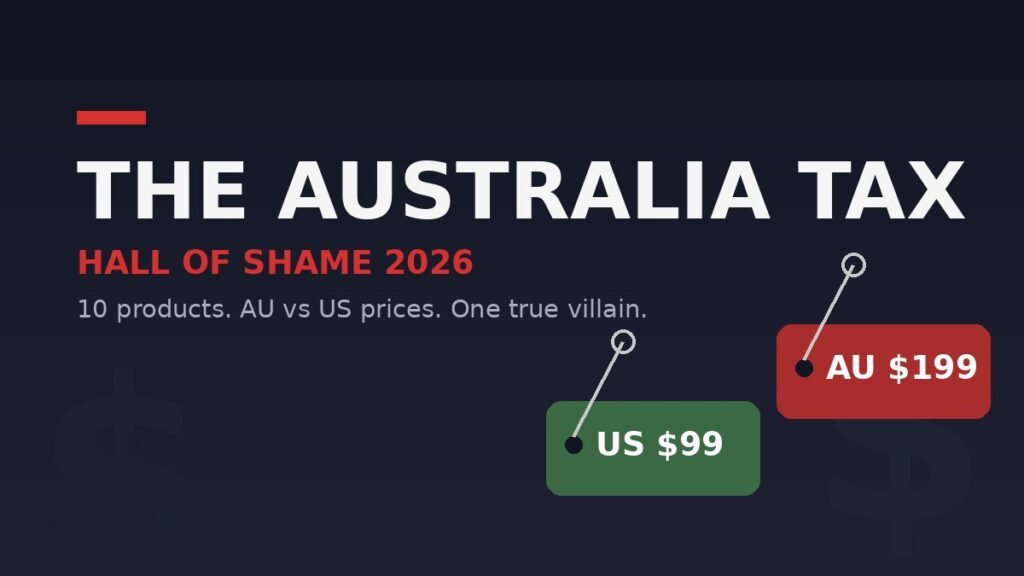
AU $199 vs US $99.99. At the real exchange rate, the US price should land at about $143.99 in Australia. Instead it sells for $199 — a 38.2% markup, or $55.01 of pure Australia Tax. And here’s the damning part: strip out the 10% GST and it’s still 25.6% over. No tax technicality explains this one away.
Google’s first smart speaker in years — the Gemini-powered Google Home Speaker 2026 we reviewed here — launched at $99.99 in the US in June 2026 (per launch coverage). Australians pay double the US sticker price in nominal terms. There is no charitable reading: this is the worst Australia Tax in our entire 50-product run, and it’s not close.
2. Samsung Galaxy Ring — 21% over (a real markup)
AU $699 vs US $399.99. Fair conversion puts it at $575.99, so Australians pay 21.4% over — $123.01 extra. Strip out GST and the gap is still 10.3%, which means GST explains less than half of this one: Samsung is charging Australians a genuine premium. Still, $699 for a first-gen smart ring stings, especially when the US price has repeatedly dropped to $299.99 on promotion.
Read our full Galaxy Ring Australia review. The US $399.99 list price is confirmed across 2026 smart-ring market data and launch coverage.
3. Apple Watch Ultra 4 — 17% over (a mild markup)
AU $1,349 vs US $799. Fair conversion: $1,150.56 — a 17.2% sticker gap. Strip out GST and the Australian price ($1,226.36 ex-GST) is still 6.6% over fair. Not egregious, but not innocent either: there’s a genuine markup here beyond the tax office’s cut.
The Apple Watch Ultra 4 at $1,349 in Australia starts from US $799 (confirmed at launch). This is the case that shows why the GST adjustment matters — without it, the gap looks twice as bad as the part Apple is actually responsible for.
4. Galaxy Buds 4 — 15% over (a mild markup)
AU $299 vs US $179.99. Fair conversion: $259.19 — a 15.4% sticker gap. Ex-GST, the Australian price ($271.82) is still 4.9% over fair. A small but real markup on Samsung’s base buds.
See our Galaxy Buds 4 vs Buds 4 Pro comparison for the full Australian price breakdown. US pricing confirmed via SamMobile’s launch coverage.
5. Ring Floodlight Cam 2K (2nd Gen) — 14% over (a small markup)
AU $329 vs US $199.99. Fair conversion: $287.99 — a 14.2% sticker gap, shrinking to 3.9% over ex-GST ($299.09). The smallest genuine markup on this list: Ring’s new 2K floodlight is close to fairly priced, but not quite there.
Our Ring Floodlight Cam 2K review has the full Australian price picture. The US $199.99 launch price is confirmed by CEPro’s launch coverage.
6. Galaxy Buds 4 Pro — 11% over (effectively fair)
AU $399 vs US $249.99. Fair conversion: $359.99 — 10.8% over on sticker, but just 0.8% over once GST is removed. The only effectively innocent entry on this list: Samsung’s flagship buds are fairly priced in Australia.
Full details in our Buds 4 vs Buds 4 Pro verdict.
Fair play: where Australia pays less than America
The Australia Tax isn’t universal. Four products in our run are priced better in Australia than a straight currency conversion would predict — and JBL, of all companies, leads the pack.
JBL Flip 7 — 19% cheaper than fair
AU $175 street vs US $149.95 list. Fair conversion: $215.93 — Australians pay 19.0% less. Honest footnote: JBL’s US store has discounted it to $109.95 at times; at that sale price, Australians actually pay about 10.5% over. But at list prices, Australia wins clearly. Our Flip 7 review has the local price evidence. US list price confirmed on JBL’s US store.
Nintendo Switch 2 Camera — 12% cheaper than fair
AU $69.95 RRP vs US $54.99. Fair conversion says $79.19 — so Australians pay 11.7% less than the exchange rate predicts. Fun detail: Nintendo raised the US price from $49.99 to $54.99 in 2025 citing tariffs, while the Australian RRP never moved. Read our Switch 2 Camera review. US price confirmed on Nintendo’s US store.
Nintendo Switch 2 Pro Controller — 8% cheaper than fair
AU $119 vs US $89.99. Fair conversion: $129.59 — Australians pay 8.2% less. Nintendo’s Australian accessory pricing is genuinely consumer-friendly right now. See our Pro Controller verdict. US price confirmed on Nintendo’s US store.
Wacaco Minipresso NS2 — 2% cheaper than fair
AU $84.90 vs US $59.90. Fair conversion: $86.26 — Australians pay 1.6% less. The portable espresso maker is one of the fairly-priced imports. See our Minipresso NS2 verdict. US pricing confirmed via Wacaco’s launch announcement.
How we calculated the Australia Tax
Every Australian price comes from our own reviews, each verified on 8 October 2026 against 2–3+ independent Australian retailers. Every US price is a verified list price from the manufacturer’s US store or reputable launch coverage — never from memory. The maths:
- Exchange rate: US$1 = A$1.44 — the actual rate on 8 October 2026 (per Google/Morningstar), stated so you can check our maths
- Fair AU price = US price × 1.44
- Sticker gap = (AU price − fair price) ÷ fair price — what you actually feel at checkout
- Ex-GST gap = (AU price ÷ 1.1 − fair price) ÷ fair price — the gap after removing Australia’s 10% GST, which is included in AU shelf prices but not in US list prices (US sales tax is added at checkout and varies by state)
We report both gaps because the honest answer needs both: the sticker gap is what your wallet feels, but the ex-GST gap is what the brand is actually responsible for. And the ex-GST gap is the one that surprised us — only one product on this list survives it unscathed.
Final verdict
The Australia Tax is real — more real than the legend’s debunkers claim. Across ten products, only one is effectively fairly priced once GST is stripped out: the Galaxy Buds 4 Pro. Everything else carries a genuine markup beyond the tax office’s cut: the Google Home Speaker 2026 at 38% over (26% even after GST) is the indefensible villain, the Galaxy Ring at 21% is a real premium, and the Apple Watch Ultra 4, Galaxy Buds 4 and Ring Floodlight Cam carry mild-to-small genuine markups of 4–7% beyond GST. On the other side, JBL, Nintendo and Wacaco are quietly giving Australians a better deal than Americans get.
The lesson for Australian buyers: don’t assume the tax — check it. Convert the US price at 1.44, knock off 10% GST from the local price, and compare. Sometimes the villain is the tax office; but when a $99 speaker sells for $199 on the same planet, in the same year — that’s a hall-of-shame entry no maths can excuse. And with that, our 50-product run is complete: fifty launches, every price verified, no filler.
Australia Tax: frequently asked questions
What is the Australia Tax?
The long-running phenomenon of Australians paying more than Americans for identical tech products, even after currency conversion. It’s been debated for over a decade — a 2013 federal parliamentary inquiry even investigated it — and it persists in 2026: our research found genuine markups beyond GST on five of the six products we ranked.
How did you calculate the Australia Tax percentages?
We converted US list prices at US$1 = A$1.44 — the actual exchange rate on 8 October 2026. Fair AU price = US price × 1.44; the sticker gap compares that against the Australian shelf price. We also computed an ex-GST gap (AU price ÷ 1.1) because Australian prices include 10% GST while US list prices exclude sales tax. Every price on both sides was verified from real sources on 8 October 2026.
Which tech product has the worst Australia Tax in 2026?
The Google Home Speaker 2026: AU $199 against a US $99.99 list price works out to 38.2% over a fair currency conversion — and it’s still 25.6% over after stripping out GST. No other product in our 50-product run comes close.
Are any tech products cheaper in Australia than the US?
Yes. The JBL Flip 7 ($175 AU vs $149.95 US list) is 19% under a fair conversion; the Nintendo Switch 2 Camera ($69.95 vs $54.99) is 12% under; the Switch 2 Pro Controller ($119 vs $89.99) is 8% under; and the Wacaco Minipresso NS2 ($84.90 vs $59.90) is 2% under. Nintendo’s Australian accessory pricing is particularly fair right now.
Is the Australia Tax just GST?
No — not entirely. Once you remove the 10% GST baked into Australian shelf prices, only the Galaxy Buds 4 Pro is effectively fairly priced (0.8% over). The rest carry genuine markups of 4–26% beyond GST: the Google Home Speaker 2026 at 25.6%, the Galaxy Ring at 10.3%, the Apple Watch Ultra 4 at 6.6%, the Galaxy Buds 4 at 4.9% and the Ring Floodlight Cam 2K at 3.9%. GST explains part of the gap — but most of these products are genuinely more expensive here.