Quick verdict
The Roborock Saros 20 is Roborock’s flagship robot vacuum in Australia — 36,000Pa of suction, a 100°C hot-water self-cleaning dock and an 8.8cm threshold-climbing chassis. The official RRP is $2,999 — and as of 8 October 2026, that’s what it costs at every major retailer: the ~$1,995–$1,998 street deals at The Good Guys and Harvey Norman have ended, and both are back at $2,999. Should you pay full $2,999? Almost certainly not — wait for the sale that Roborock flagships reliably deliver. Should you pay ~$2,000 if the street price drops again? For a large home with mixed floors and pets, yes.
Roborock Saros 20: Australian price and where to buy cheapest
Here’s the current price picture (checked 8 October 2026):
$2,999 — Roborock Australia (official online store), the Australian RRP.
$2,999 — The Good Guys — the $1,995 street deal has ended; back at RRP.
$2,999 — Harvey Norman — the $1,998 deal has ended; back at RRP, listed in stock.
A word of caution: robot vacuum pricing in Australia moves constantly. The $1,995–$1,998 deals at The Good Guys and Harvey Norman ended in early October 2026 — both are now back at the $2,999 RRP. JB Hi-Fi’s listing remains pulled. If the street price drops back toward $2,000, we’ll update — Roborock’s pricing history says the discounts always return.
Roborock Saros 20: key features and specs
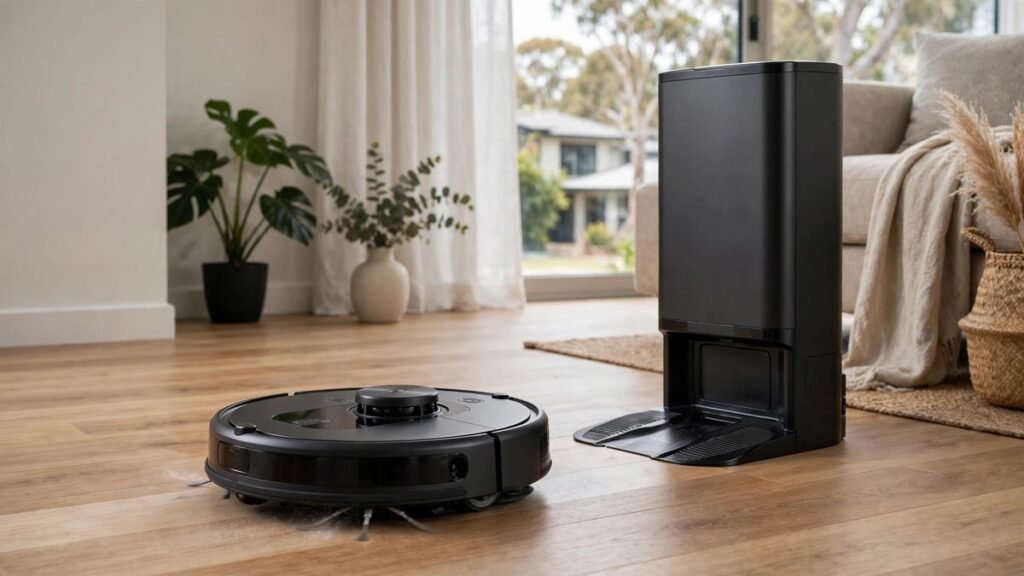
The Saros 20 was unveiled at CES in January 2026 and launched in Australia in April 2026 as the successor to the Saros 10. The headline number is 36,000Pa of HyperForce suction — up from 22,000Pa on the Saros 10 — making it one of the strongest suction figures on any robot vacuum in Australia. It mops with dual spinning mop pads and a self-cleaning dock that washes them with 100°C hot water, then dries with 55°C warm air, with automatic dust emptying, warm-water auto refilling and intelligent dirt detection that rewashes and remops as needed.
The standout engineering story is the AdaptiLift chassis, which climbs double-layer thresholds of up to 8.8cm — thick rugs, raised door tracks and small steps between rooms that trap most robot vacuums. The robot itself is only 7.95cm tall, so it slides under low furniture while the mapping stays precise. Navigation is Roborock’s StarSight Autonomous System 2.0, which recognises over 300 obstacle types (cables, shoes, pet mess) and steers around them, and SmartPlan adapts cleaning strategy to room types, floor surfaces and cleaning history.
Onboard capacity is a deliberate trade-off for the slim design: a 180mL onboard dustbin (small by flagship standards) that the dock empties automatically between sessions, plus a 4-litre clean-water tank feeding the mop system. Voice control is built in — “Hello Rocky” works without a phone — and the app handles multi-floor mapping, no-go zones and room-specific routines. It carries a 2-year Australian warranty.
What justifies $2,999 — and what doesn’t
What’s worth paying for: the 36,000Pa suction is genuinely top-of-class and matters on carpet and in pet homes; the AdaptiLift threshold climbing solves a real-world problem (transition strips, shaggy rugs) that cheaper bots can’t; the 100°C hot-water dock wash keeps the mops hygienic without your involvement; and the 7.95cm slim body plus 300+ obstacle recognition means it cleans where other flagships get stuck or beached.
What’s harder to justify: at $2,999 RRP, it still uses rotating mop pads rather than the roller-mop systems newer rivals (and even some Roborock models) have moved to — an older technology at flagship money. The tiny 180mL dustbin relies on the dock doing its job well every time. And as TechRadar’s review put it, some of the capabilities are “nice-to-haves rather than essentials” — you can get very close to this performance from a cheaper machine with very little compromise. Their value-for-money score was 3.5 out of 5.
The honest maths: at $2,999 — the current price everywhere — nothing on this spec sheet is worth the RRP on its own. The value used to live at the ~$2,000 street price; with those deals gone, patience is the play: wait for the sale Roborock inevitably runs.
How it compares to the competition at Australian prices
The closest internal rival is the Roborock Qrevo Edge 2 Pro ($2,799 RRP, currently discounted to $2,299 at launch pricing) — positioned as the alternative flagship with a longer battery and bigger dustbin for large homes. And on the horizon: the Saros 20 Flow ($2,799 announced) with a roller mop design and more downward pressure for sticky messes, plus the Qrevo Edge 3 Pro ($2,799) — Roborock is crowding its own lineup at the top end, which is exactly why the base Saros 20’s discounts will likely return.
The sharpest comparison is the Dreame X50 Ultra — last year’s $2,999 flagship, now $1,795 cheapest at JB Hi-Fi (its $1,299 clearance ended). It’s a generation older but at that price it’s the value benchmark every $2,999 flagship has to survive: if the Saros 20’s street price ever dips toward $2,000, it’s an instant buy; at $2,999 versus the X50 at $1,795, you’re paying $1,204 for newer obstacle AI and better threshold climbing. Read our Dreame X50 Ultra clearance breakdown before deciding.
The Mova Z60 Ultra Roller Complete at $1,399 is another roller-mop rival worth a look — newer mopping tech at half the Saros 20’s RRP. And if you’re cross-shopping the Saros 20 against its closest rival head-on, our Narwal Flow 2 vs Roborock Saros 20 comparison goes deep on the differences.
Who should buy it
Buy the Saros 20 if: you have a large home with mixed floors (hard floors plus carpet) and pets — the 36,000Pa suction and obstacle AI earn their keep daily; your home has raised thresholds, thick rugs or transition strips that defeat other robots (the AdaptiLift climbing is genuinely differentiated); you want a fully hands-off routine — auto-empty, hot-water mop wash, auto-refill.
Think twice if: you’re paying $2,999 — which is the price everywhere right now; at full RRP the value argument collapses, and a patient buyer will be rewarded; your home is small or single-level with low thresholds, where a mid-range bot cleans just as well; you want the newest mopping tech (roller mop) — the upcoming Saros 20 Flow or the Mova Z60 Ultra Roller are the ones to watch; or you prefer a bigger onboard dustbin and longer battery over ultimate suction (the Qrevo Edge 2 Pro leans that way).
The pricing rule is the whole review. At $2,999 — the current price everywhere: wait. Buy it on sale at ~$2,000 or under: yes, worth it for the right home. Roborock releases new models fast and discounts the old flagships faster — the price you pay matters more than anything else about this machine.
Final verdict
The Roborock Saros 20 is one of the most capable robot vacuums you can buy in Australia: best-in-class suction, excellent obstacle avoidance, threshold-climbing that genuinely solves a problem, and a dock that handles almost everything except refilling its own water. But as of 8 October 2026, the ~$2,000 street deals at The Good Guys and Harvey Norman are over — it’s $2,999 everywhere. At full RRP it’s not worth it — not because it’s a bad machine, but because the rotating mop pads, small dustbin and rapid model turnover mean you should never pay launch price. Wait for the sale Roborock inevitably runs.
Frequently asked questions
Is the Roborock Saros 20 worth $2,999 in Australia?
Right now, no — the ~$1,995–$1,998 street deals have ended and it’s $2,999 at every retailer we checked (8 October 2026). At a discounted street price of ~$2,000 or under, it would be a much stronger proposition: best-in-class 36,000Pa suction, excellent obstacle AI and threshold climbing that few rivals match. Never pay launch price for a Roborock flagship; wait for the sale.
Where is the cheapest place to buy the Roborock Saros 20 in Australia?
As of 8 October 2026, there’s no standout cheapest retailer — it’s $2,999 at The Good Guys, Harvey Norman and Roborock’s own store. The $1,995–$1,998 deals at The Good Guys and Harvey Norman have ended. Retailer pricing moves fast on robot vacuums, so the play right now is to wait for the next sale.
What’s the difference between the Saros 20 and the Saros 10?
The Saros 20 succeeds the Saros 10 with suction up from 22,000Pa to 36,000Pa, the new AdaptiLift chassis for climbing 8.8cm thresholds, a slimmer 7.95cm body, StarSight Autonomous System 2.0 obstacle recognition (300+ object types) and SmartPlan room-aware cleaning. The dock keeps hot-water mop washing and auto-emptying.
Can the Saros 20 cross high thresholds and thick rugs?
Yes — that’s one of its standout features. The AdaptiLift chassis climbs double-layer thresholds up to 8.8cm (4.5cm + 4.3cm), which handles thick rugs, raised door tracks and small steps between rooms that trap most robot vacuums. It’s designed for exactly the homes other flagships struggle with.
Should I buy the Saros 20 or wait for the Saros 20 Flow?
It depends on your floors. The Saros 20 Flow (announced at $2,799) uses a roller mop with more downward pressure for sticky messes on hard floors, while the base Saros 20 uses spinning mop pads. If your priority is mopping power on tile and timber, the Flow is worth waiting for; if you want maximum suction for carpet and pet hair — and a discounted ~$2,000 deal reappears — the base Saros 20 is the pick. See our Narwal Flow 2 vs Saros 20 comparison for the closest rival head-to-head.